

If you've been told you need surgery and your doctor has mentioned the word "laparoscopic," you're probably picturing something far less daunting than the traditional open operations your parents or grandparents went through. You're right to feel that way. Laparoscopic surgery - also called "keyhole" or "minimally invasive" surgery- has transformed how common abdominal and pelvic conditions are treated, and Hyderabad has emerged as one of India's leading hubs for this kind of care.
This guide covers three core services we specialize in: laparoscopic surgery, laparoscopic hysterectomy, and laparoscopic tubectomy - what each involves, who it's for, what recovery looks like, and the questions worth asking before you decide.
Laparoscopic surgery is a technique where, instead of making one large incision to open up the abdomen, the surgeon makes a few small incisions - typically 0.5 to 1.5 cm each. Through one of these, a thin tube fitted with a high-definition camera (the laparoscope) is inserted, projecting a magnified, well-lit view of your internal organs onto a monitor in the operating room. Through the other small incisions, the surgeon passes long, slender instruments to perform the actual operation, guided entirely by what's on the screen.
Because the abdominal muscles and tissue aren't cut open the way they are in traditional surgery, the body experiences significantly less trauma. This single difference cascades into nearly every benefit associated with the technique - from how much pain medication you'll need, to how soon you can return to work, to how visible your scars will be a year from now.
Procedure duration varies from 30 minutes for straightforward cases to 2 hours or more for complex operations. Your surgeon will give you a specific estimate based on your case.
Most patients are good candidates for a laparoscopic approach, but certain factors influence the decision, including:
None of these automatically rule out laparoscopic surgery - they are simply factors your surgical team will carefully assess during your pre-operative evaluation. A good surgeon will always tell you honestly if an open approach is safer for your specific situation.
Most patients are encouraged to start moving - sitting up, walking short distances - within hours of waking from anesthesia. Early mobilization reduces the risk of blood clots and helps the bowels resume normal function sooner.
General recovery timelines:
Your surgeon will provide a personalized recovery plan including wound care instructions, activity restrictions, dietary guidance, and a structured follow-up schedule.
A hysterectomy - the surgical removal of the uterus - is one of the most significant gynecological procedures a woman can undergo. When performed laparoscopically, it is also one of the most refined: smaller incisions, significantly less pain, a hospital stay measured in days rather than a week or more, and a return to normal life in 2 to 4 weeks rather than 6 to 8.
Read our complete guide on laparoscopic hysterectomy in Hyderabad for full procedure details, recovery timeline, and cost.
A hysterectomy is typically recommended when other treatments have been tried or considered and the condition is significantly affecting quality of life. Common reasons include:
A hysterectomy is an irreversible decision - it ends the ability to conceive - and is recommended only after a thorough discussion of all available alternatives and a clear understanding of your symptoms, diagnosis, and personal priorities.
The specific approach depends on your anatomy and the nature of your condition:
Your surgeon will recommend the most appropriate type based on your diagnosis, uterine size, and surgical history.
The procedure takes approximately 1 to 2.5 hours, depending on uterine size and complexity.
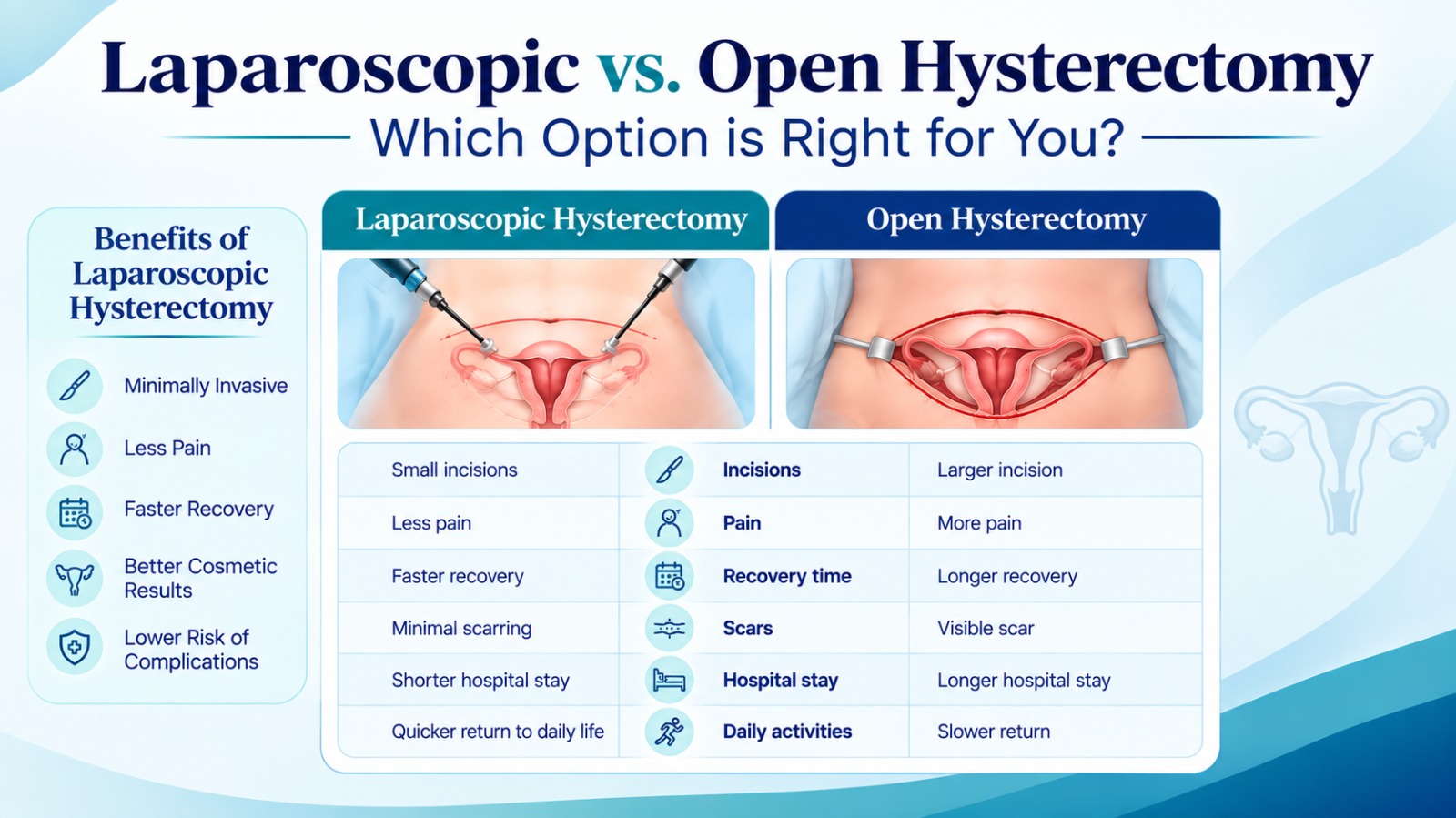
| Factor | Laparoscopic | Open (Abdominal) |
|---|---|---|
| Incision | 3–4 small cuts (under 1.5 cm) | Single large cut (10–15 cm) |
| Hospital stay | 1–3 days | 4–7 days |
| Pain level | Mild to moderate | Moderate to significant |
| Return to normal activity | 2–4 weeks | 6–8 weeks |
| Scarring | Minimal | More visible |
| Blood loss | Lower | Higher |
| Timeframe | What to Expect |
|---|---|
| Week 1 | Rest at home, light walking, manageable pain with medication |
| Week 2 | Energy improving, light household tasks resume |
| Week 3–4 | Most patients return to desk-based work |
| Week 6+ | Full recovery, return to exercise and sexual activity once cleared |
This depends on whether the ovaries are preserved:
This is a critical conversation to have with your surgeon before the procedure, as it affects both short-term recovery and long-term wellbeing.
Tubectomy - also called tubal ligation or female sterilization - is a permanent contraceptive procedure in which the fallopian tubes are blocked, sealed, or removed, preventing eggs from reaching the uterus. When performed laparoscopically, it is a brief, well-tolerated procedure that most women recover from within a week.
Read our complete guide on laparoscopic tubectomy in Hyderabad for full procedure details, recovery timeline, and what to expect.
Tubectomy is appropriate for women who:
Because it is intended to be permanent and irreversible, tubectomy requires thorough counseling and a fully informed, voluntary decision. It is not the right choice for women who are unsure about future pregnancy plans - in those cases, highly effective but reversible alternatives such as the copper IUD or hormonal implant are more appropriate.
The procedure typically takes 20 to 45 minutes and is performed as a day-care or overnight-stay procedure.
| Method | How It Works |
|---|---|
| Bipolar coagulation | Electrical current seals a section of the tube |
| Tubal clips (Filshie clips) | Mechanical clamps block the tube |
| Tubal rings | Small silicone rings constrict the tube |
| Salpingectomy | Partial or complete removal of the tube |
Your surgeon will discuss which method is most appropriate for your case, including its specific effectiveness rate and implications for any future reversal consideration.
A common concern - and one worth addressing clearly:
| Timeframe | What to Expect |
|---|---|
| Day 1–2 | Mild abdominal soreness, rest at home |
| Day 3–4 | Discomfort reduces, light daily tasks manageable |
| Day 5–7 | Most patients feel close to normal |
| Week 2 | Return to work and normal routine |
| Week 3–4 | Cleared for exercise and strenuous activity |
The contraceptive effect is considered immediate after the procedure. Your surgeon will confirm this and advise on any short-term backup contraception if needed.
Whether you are considering laparoscopic surgery, hysterectomy, or tubectomy, choosing the right surgeon is the most important decision in the entire process. Here's what to look for:
Walking into your first surgical consultation prepared makes a real difference:
Costs vary depending on the specific procedure, hospital, surgeon experience, room category, and whether any complications arise. Generally, laparoscopic procedures in Hyderabad are priced competitively compared to other major Indian cities, while maintaining surgical standards and equipment comparable to the best centers in the country.
Key cost components for any laparoscopic procedure include:
Most major health insurance plans in India cover laparoscopic hysterectomy and tubectomy when performed for a confirmed medical indication. It is worth confirming coverage, cashless facility availability, and pre-authorization documentation requirements with your insurer before scheduling.
For an accurate estimate specific to your case, request a detailed, itemized cost breakdown directly from your surgeon's office.
Laparoscopic surgery, hysterectomy, and tubectomy each represent a different need a condition to treat, a uterine problem to resolve, or a permanent contraceptive decision but they share a common foundation: minimally invasive technique that reduces pain, shortens recovery, and lets you return to your life faster than traditional open surgery would allow.
If you are considering any of these procedures, the right starting point is a thorough consultation with a surgeon who has specific experience in laparoscopic gynecological procedures, takes the time to understand your goals, and explains your options honestly. The right surgical partner makes all the difference in how confidently you move forward and how smoothly your recovery goes. For More Information Book an Appointment
Written by Dr. K. Anusha Chowdary
Consultant Gynaecologist, Laparoscopic Surgeon & Fertility Specialist
Disclaimer: This article is intended for general informational purposes and does not replace personalized medical advice. Please consult a qualified surgeon to discuss your specific condition and treatment options.